
When individuals embark on strength training, they observe that muscles react differently in the manner in which they train. Certain exercises will leave the muscles thicker and larger. Others will raise the strength by a huge margin without necessarily producing the same pump. These adaptations occur due to the alterations of the muscles to resistance training in several aspects.
At this point, one would be interested in the Sarcoplasmic Hypertrophy vs Myofibrillar Hypertrophy. These two hypertrophy types are used to explain the various biological processes that lead to the development of the muscles. Although they both have the role of building muscles. They are known to have varying effects on muscle size, strength, and endurance.
Besides the choice of training style, issues of nutrition, hydration, recovery, and electrolyte balance also contribute to muscle growth and performance. These factors are optimized. And this means that the body is in a better position to sustain these two forms of hypertrophy in the long run.
Sarcoplasmic Hypertrophy vs Myofibrillar Hypertrophy (Quick Comparison)
A lot of individuals seeking Sarcoplasmic Hypertrophy vs Myofibrillar Hypertrophy are seeking a brief explanation to further expand their horizons. The following table outlines the major differences between the two mechanisms of muscle growth.
| Feature | Sarcoplasmic Hypertrophy | Myofibrillar Hypertrophy |
| Main Goal | Increase muscle size | Increase muscle strength |
| What grows | Muscle cells Fluid and glycogen. | Muscle fiber density |
| Typical Training | High reps (8–15+) | Low reps (3–6) |
| Weight Used | Moderate | Heavy |
| Rest Time | Short | Longer |
| Common Among | Bodybuilders | Powerlifters |
The majority of training programs cause simultaneous stimulation of both adaptations. Although the proportion between them is determined by training style, intensity, and volume of workouts.
What Is Sarcoplasmic Hypertrophy?
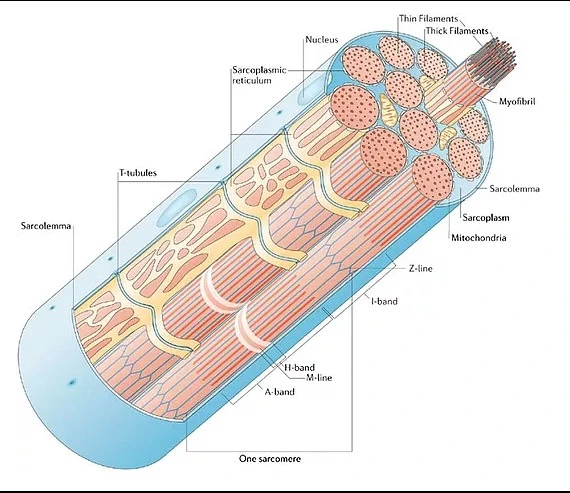
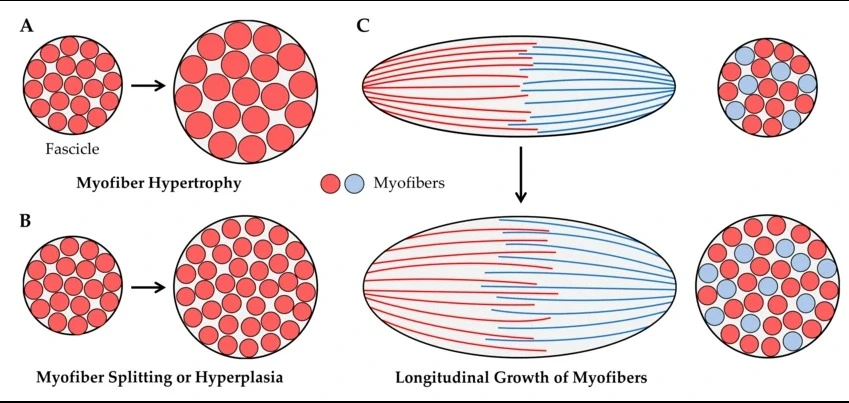
Sarcoplasmic hypertrophy is a disorder of increasing sarcoplasm, or the water of the muscle cells, which encloses the contractile fibers. All this fluid contains glycogen, enzymes, minerals and water, which are used to produce muscular energy when one is engaged in an exercise.
When an individual engages in high-volume resistance training, the muscles acquire the ability to store more glycogen. This growth of the sarcoplasm causes changes in the overall size of the muscle cell. It can make the muscles appear more pumped up.
This form of hypertrophy has been linked to the type of workouts done in bodybuilding. Whereby there is always an emphasis on developing the size and symmetry of the muscles. The athletes who undergo this kind of training often report a high rate of muscle pump during exercise. Since the muscle cells are dilated due to an increase in blood circulation and glycogen storage.
What Is Myofibrillar Hypertrophy?
Myofibrillar hypertrophy is concerned with growing the size and the number of myofibrils or the contractile fibers within the muscle cells that give out force during movement.
This form of hypertrophy reinforces the structural components of the muscle fibers themselves as opposed to increasing muscle cells. This leads to increased strength, power, and force production by the athletes.
This is especially crucial to athletes whose training is based on maximum strength, like powerlifters and Olympic lifters, as well as competitive strength athletes.
Training Styles of Sarcoplasmic Hypertrophy vs Myofibrillar Hypertrophy
Sarcoplasmic Hypertrophy Training Style
The exercises that can assist in the induction of sarcoplasmic hypertrophy usually include the following:
- 8–15 repetitions per set
- Moderate weight loads
- Short rest intervals
- Higher total workout volume
This method raises the metabolic pressure, thereby inducing the body to build up more muscle cell stores of energy. This results in higher levels of strength, power and force production by the athletes.
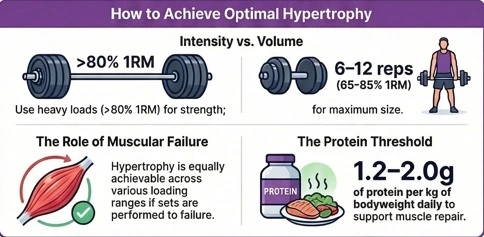
This is particularly essential to athletes whose training is founded on optimum strength, such as powerlifters and Olympic lifters, and also to athletes who compete based on strength.
Myofibrillar Hypertrophy Training Style
The following are some of the activities that are normally included in training programs that are meant to spur this kind of growth:
- Heavy weights
- Reduced periods of repetition (3 6 reps).
- Increased interval between sets.
- Reduction in total training volume.
These exercises put a high strain on muscle fibers. This tension indicates in the long run that the body tries to reinstate and tighten the contractile structures within the muscles.
Popular Sarcoplasmic Hypertrophy vs Myofibrillar Hypertrophy: Which Is Best?
Sarcoplasmic Hypertrophy and Myofibrillar Hypertrophy make individuals question which of the two options is superior. As a matter of fact, there is no basic advantage to either of the approaches. Rather, they are used for different purposes depending on the intentions of the athlete.
Sarcoplasmic hypertrophy is the type of muscle development that is usually focused on by bodybuilders since their interest is to grow as big as possible and look like bodybuilders. High-volume training style makes muscles store more glycogen and fluid, thereby giving them a fuller appearance.
On the contrary, myofibrillar hypertrophy is a top priority of strength athletes since their main goal is to enhance strength and force output. Most trainers who are experienced suggest the use of the two training styles together.
How to Achieve Both Types of Hypertrophy
The most efficient training regimes have realized that these two types of hypertrophy are contributory to long-run muscle growth. Many athletes do not necessarily use either of the methods, but rather a combination of the two in their weekly workouts.
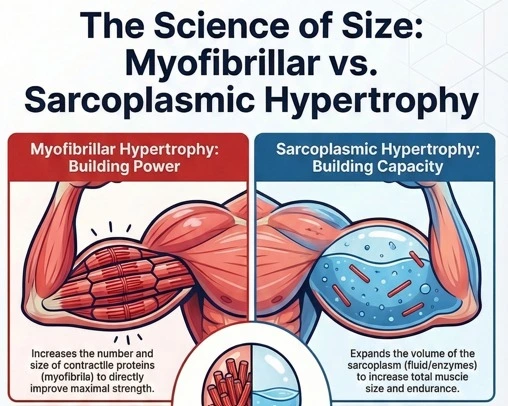
Examples include strength-based exercises with fewer repetition ranges consisting of heavy compound exercises, squats, deadlifts, and bench presses. These exercises produce the mechanical tension that is required in myofibrillar hypertrophy.
During other training days, athletes can use moderate weights that have increased repetition scales, isolation training, and reduced rest rates.
Hydration and Recovery During Hypertrophy Training
Hydration is one of the factors that are not always taken into consideration when hypertrophy training is discussed. Excessive resistance training exercise causes considerable loss of fluid and electrolytes in the form of sweat, particularly in the high-volume exercises.
Sodium, potassium and magnesium are electrolytes that are very crucial in ensuring muscle contractions, nerve transmissions and balance of fluids in the body. Once these minerals are consumed, the athletes are likely to suffer fatigue, loss of endurance and cramping of muscles.
This is the reason why athletes seek hydration drinks other than water. In the recent past, new electrolyte formulas started to emerge in the sport nutrition arena, which provided hydration in a more holistic manner.
Cellular Hydrate Electrolyte Powder is one of the examples that are drawing a crowd of people interested in fitness. Some of the formulas such as Cellular Hydrate are based on more performance-oriented ingredients as compared to other traditional hydration mixes.
Protein Consumption and Muscle regeneration
Training is the stimulus to muscle growth but a combination of nutrition is the building block to repair and strengthen muscle tissue.
In resistance training, micro-tears are developed in the muscle fibers. When these fibers are repaired by the body, they are made stronger and a bit bigger. Amino acids are essential to this process and are found in protein in the diet.
Whole foods, including lean meats, dairy products, and eggs, are some of the whole foods that satisfy the protein needs of many athletes. Protein supplements are, however, an option to others who want to augment their daily intake.
One of the products that are being researched by some fitness enthusiasts is Spiritual Armor Whey Protein Isolate (Vanilla). Whey protein isolate has a rapid absorption rate and is rich in amino acids, hence widely used in post-workout recovery.
Conclusions about Sarcoplasmic Hypertrophy vs Myofibrillar Hypertrophy
Sarcoplasmic Hypertrophy vs Myofibrillar Hypertrophy, this knowledge could help the athletes to be able to train more strategically. Resistance training is just another type of body adaptation of mechanisms.
Sarcoplasmic hypertrophy swells the mass of muscle due to the enlargement of quantities of fluid and glycogen. It has muscle cells and myofibrillar hypertrophy boosts muscle strength by growing the contractile fibers that produce muscle force.
The best training programs are the ones that are based on the integration of the two strategies rather than the choice of either one. Once all these are implemented, the athletes will be capable of building more powerful, larger, and stronger muscles and will continue their training process.
Connect With Us on Social Media
Follow us on social media to be motivated, be up-to-date, and be part of an encouraging community of people that focus on recovery and well-being. So, join us today and make a journey to a healthier, sober life!
Follow and connect here:
Visit our shop below to get the foundation you need!
 English