
If you ever felt lost over calories, how much you needed to eat, or why you were not losing weight, then you were not alone. The problem with most people is that they are simply dieting or exercising, but they fail to see the bigger picture, which is your body as a whole energy output.
That plan is referred to as Total Daily Energy Expenditure (TDEE). It is the total amount of calories burnt by your body throughout one complete day since waking up in the morning until going to sleep.
Knowledge of TDEE is very influential as it eliminates speculation. You start to understand the way your body is using the calories instead of just cutting them out blindly or overtraining without actually knowing what is going on in your body. More to the point, where you can make a difference.
What is particularly intriguing with TDEE is that there is more than only workouts. In fact, organized exercise is usually the least contributor. The metabolism rate, the daily activity, and even the food you eat burn your calories.
TDEE is not such a complicated concept when you dissect it. The more useful things you can implement in your day-to-day activity, be it the loss of fat, the building of muscle, or just the maintenance of a healthy life, the better.
What Makes Up Your TDEE?
There are four components that compose TDEE. They all play a different role and when you know them all, you can maximize your output rather than have to use trial and error.
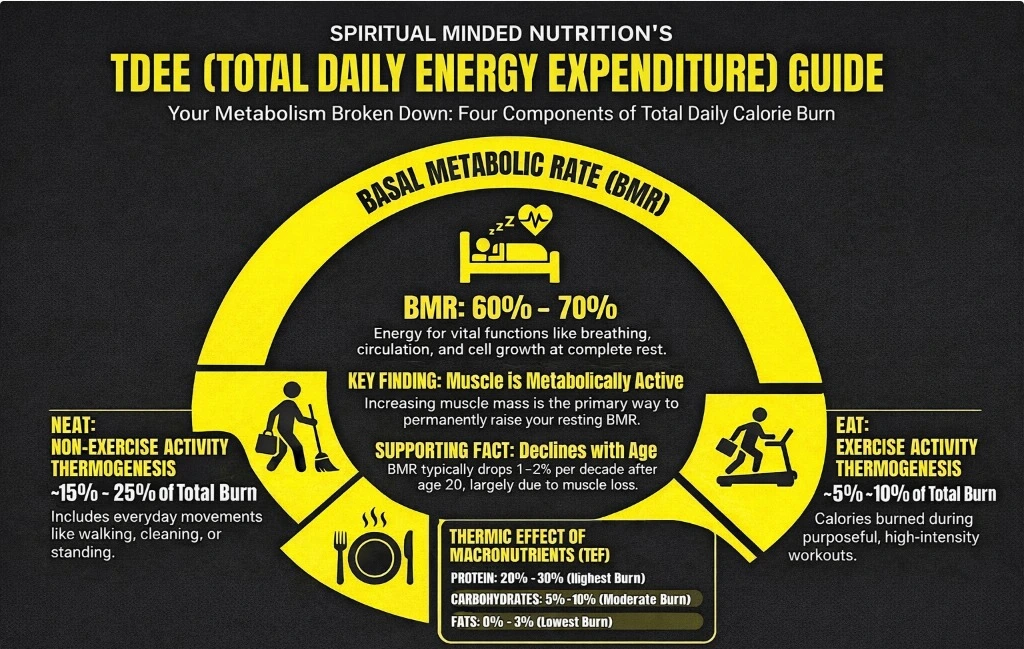
1. BMR (Basal Metabolic Rate) – 60-70 % of TDEE
Your body is burning calories even before workouts, steps, or even eating so that you can continue to breathe. This is because it is constantly used in the background. energy, which makes BMR the basis of your entire metabolism and the most significant contribution to your daily calorie expenditure.
The biggest source of calories burned in a day is Basal Metabolic Rate. It means the amount of energy that is required by your body to carry out necessary processes that support life when in perfect rest.
This includes:
- Blood flow in the lungs and blood flow through the arteries.
- Cardiac circulation and functioning.
- The nervous system and the brain activity.
- Repair of cells, their growth, and control of hormones.
You can gain so much weight and not do any activity all day but the number of calories that your body will utilize by BMR alone will be a lot of calories.
Why it matters so much:
BMR normally contributes approximately 60 percent of your TDEE, with some sources going up to 70 percent in other cases with regard to an individual. To a majority of the people, however, 60 is a realistic and practicable average.
What influences your BMR?
- Muscle (the more the muscle, the greater the BMR)
- Age (BMR decreases with time)
- Gender and hormones
- Genetics
2. NEAT (Non-Exercise Activity Thermogenesis): 25 percent
The gym does not provide all the calories burned. Indeed, much of what you use as energy each day is in little, almost invisible motions that you make over the course of the day that you do not even bother to consider.
Non-Exercise Activity Thermogenesis is the total amount of calories burned by non-exercise forms of movement.
This includes:
- Strolling through your work environment or house.
- Using the steps rather than the lifts.
- Washing, preparing meals, or running errands.
- Fidgeting, standing, and changing position.
Why NEAT is so powerful:
NEAT may differ radically across people. The other people simply burn up more calories throughout the day, and this could easily make them lose hundreds of calories a day without necessarily having to work out.
Take the case of someone who exercises (walks a lot and gets up more than he sits); he may burn many calories compared to someone who is not active (he/she exercises as much as possible in the gym) despite the fact that they both spend the same amount of time in the gym.
Real-world impact:
The easiest and most efficient method of losing fat without straining your body is by increasing NEAT.
3. TEF (Thermic Effect of Food) ~10%
When you eat, it is not simply that your body absorbs calories: it costs your body to process the food that you eat. This unreported price of digestion is a slight, yet significant, part of your daily calorie expenditure.
Thermic Effect of food is the energy that your body needs in order to digest, absorb and process the food you are consuming.
The body attempts to:
- Break down nutrients
- Take vitamins and minerals.
- The food can be converted to productive power.
This process requires the utilization of calories and contributes about 10 percent of TDEE.
Not all foods are equal:
- Protein: it burns 20-30 percent of its calories in digestion.
- Carbohydrates: 5–10%
- Fats: 0–3%
What this means for you:
The higher protein diet is not only a muscle-building diet but it also burns a few more calories. It is also useful in satiety and hence, control of total calories is easily achieved.
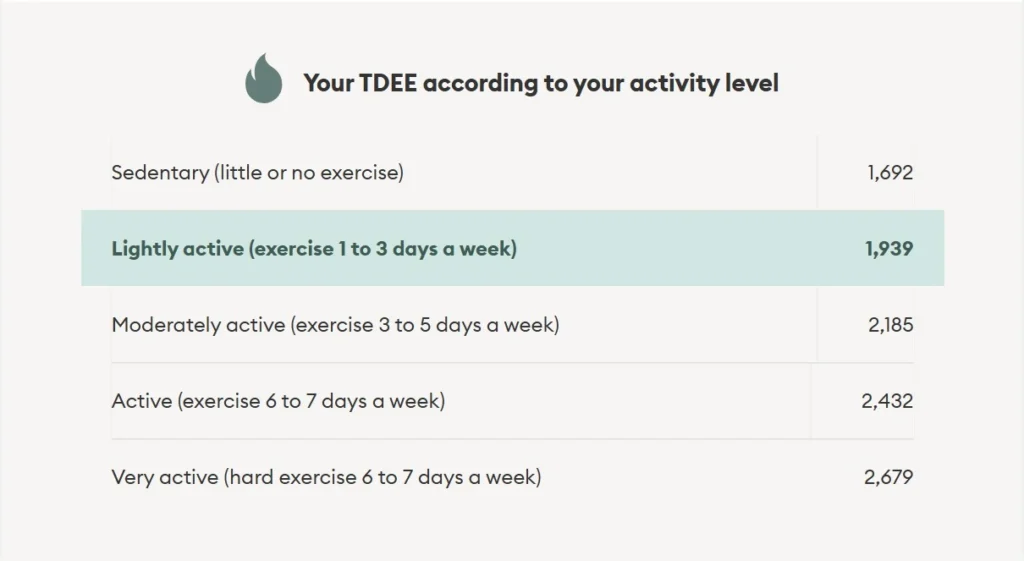
4. EAT (Exercise Activity Thermogenesis) ~5%
Whenever the majority of the population behaves calorie-burning, it automatically comes to mind: workouts. Although exercise does matter, it constitutes a lower percentage of your daily calorie expenditure than most people would care to acknowledge.
Exercise Activity Thermogenesis is the amount of calories burned during planned exercise.
This includes:
- Weight training
- Running or cycling
- Exercises and vigorous exercises.
Exercise alone does not take up much of the total daily energy expenditure, and most people have an average of 5 percent of energy cost as a proportion of exercise.
Why it’s still essential:
Although EAT is the least important in the burning of calories, it has some strong indirect advantages:
- Enhances heart-related well-being.
- Develops power and stamina.
- Improves with time metabolism.
- Supports mental well-being
Walking vs Resistance Training: Which Is More Effective?
This analogy tends to be confusing, yet they are needed to fulfill varying functions in your TDEE.
Walking (Low-Intensity Movement)
NEAT is mainly increased by walking.
Advantages:
- Simple to do on a daily basis without exhaustion.
- Sustainable long-term
- Helps eat at a deficit of calories.
- Promotes wellness and health.
Since it is low intensity, walking can be done regularly, thus being a regular source of calories burned.
Resistance Training (Strength Training)
The main effect of resistance training in relation to your BMR is increased muscle mass, which in turn increases your BMR.
Advantages:
- Builds lean muscle mass
- increases resting calorie expenditure.
- Improves body composition
Produces a post-training effect (you will be burning more calories even after the workout is over). Compared to walking, resistance training produces long-term metabolic adaptations and is thus crucial to the long-term loss of fat.
Walking vs Resistance Training: Comparison Table
| Factor | Walking | Resistance Training |
| Primary Impact | Increases Non-Exercise Activity Thermogenesis | Increases Basal Metabolic Rate |
| Calorie Burn (Short-Term) | Moderate, steady | Moderate to high |
| Calorie Burn (Long-Term) | Depends on consistency | Increases due to muscle gain |
| Muscle Building | Minimal | High |
| Fat Loss Efficiency | Good with consistency | Highly effective with muscle gain |
| Afterburn Effect | Very low | Moderate to high |
| Sustainability | Very easy to maintain daily | Requires planning and recovery |
| Injury Risk | Very low | Moderate (if improper form) |
| Best For | Beginners, daily activity, recovery | Strength, muscle growth, metabolism boost |
The Smart Approach: Combine Both
Rather than deciding in favor of one and against the other, it is best to combine both.
- Walking burns more calories each day (NEAT).
- Resistance exercise raises the resting metabolism (BMR).
As a unit they generate a harmonious and very successful system.
Ideal routine example:
- Exercising daily or physical activity is beneficial.
- 3-4 fitness sessions in a week.
This strategy promotes fat burn, muscle composition, healthy living and living without a lot of overwork.
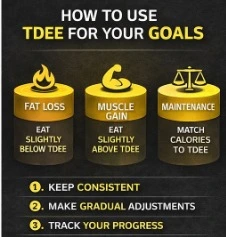
How to Use TDEE for Your Goals
It is based on knowing your TDEE which will place you in the right direction:
- To lose fat: Have a slight deficit of your TDEE but be active.
- To build muscle: Resistance training with a slight increase over TDEE.
- To maintain: Adjust the same to your TDEE.
It is consistency and gradual changes, but not drastic changes. Making small, sustainable changes will never fail to yield better results than the drastic ones, which are forced and short-term.
Conclusion
TDEE is not a static figure that you can solve with one number and leave behind you but an active image of the body in relation to movement, food, and lifestyle on a daily basis.
Once you know that BMR is the key to your calorie expenditure, that NEAT can work silently and generate day-in, day-out energy, that TEF can help you through nutrition, and that EAT can help you work and exercise, you start to think that perfection is always found in moderation, not indulgence.
Rather than looking at fast solutions, when you manage to combine all four elements, you can build a long-term system in which fat loss, muscle gain, and health in general become more predictable, controllable, and sustained.
Connect With Us on Social Media
Follow us on social media to be motivated, be up-to-date, and be part of an encouraging community of people that focus on recovery and well-being. So, join us today and make a journey to a healthier, sober life!
Follow and connect here:
Visit our shop below to get the foundation you need!
 English