

Why calories matter, why food quality matters more than you think, and how to make both work for you.
The Big Confusion
You have heard two camps, and both are wrong. Both are right. Here is the truth.
Camp One: Calories, calories, calories. Calories in = Calories out. 2000 calories from the chicken are equal to 2000 calories from the cookies. A calorie is a calorie, and that’s what it means.
Camp Two: “Calories don’t count; hormones do. Insulin is the fat storage hormone. Sugar spikes insulin. Protein does not. 100 calories of cookies equals 100 fat cells. Stir in 100 calories of steak. Stir in 100 calories of steak. Not all calories are created equal.
Both camps are half-right. Both camps don’t have the whole picture.
How they fit together. This is how you make it to the winner.
“Do you not know that your bodies are temples of the Holy Spirit?” — 1 Corinthians 6:19
Your temple needs fuel. Let us talk about what kind.
Before you rebuild your nutrition, secure Cellular Hydrate Electrolyte Formula. This is your baseline. Everything else builds on top.
1. Calories Still Run the Math — You Can’t Escape Physics
Physics can never be avoided. You can’t use the law of energy balance as an option.
When one consumes more calories than consumed by the body, energy is stored. When your energy intake is less than your energy expenditure, you don’t gain in energy. There is no body that can make weight out of air.
The science: Scientists lock people up in a science lab and micromanage their food intake in metabolic ward studies. When calories and protein are the same, there is little difference between carb-to-fat ratios as far as fat loss is concerned. One NIH study included individuals on both low-carb and low-fat diets for six days, at the same number of calories. Despite the much greater reduction in insulin levels on low-carb, fat loss was practically the same.
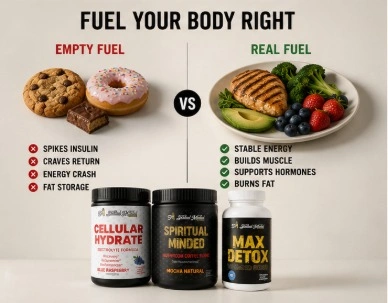
Snack cakes can be a good meal to eat that enables you to shed pounds as long as they don’t contain as many calories as needed. You’ll be very uncomfortable. Your performance will be affected. However, the scale will come into motion.
Why? Twenty-four-hour energy balance still prevailed.
Calories are a maximum.
Max Detox from SpiritualMindedNutrition.com helps reset your system when you transition from processed foods to whole foods. Flush the garbage. Start clean.
2. But Not All Calories Behave the Same in Your Body
Here is where “a calorie is not a calorie” is actually true. Three reasons.
A. The Thermic Effect of Food
It costs energy to digest food. Not all macros cost the same.
| Macro | Calories Burned During Digestion |
| Protein | 20-30% |
| Carbs | 5-10% |
| Fat | 0-3% |
A hundred calories of protein is about seventy to eighty calories. A 100-calorie serving of sugar provides about 90-95 calories of the sugar equivalent of the food.
Proteins burn 100-150 more calories per day when consumed in a 2,000 calorie diet due to digestion alone. Small. But real.
B. Insulin and Fat Storage
Insulin is a storage hormone. Promotes uptake of glucose by cells. It turns off fat-burning. Carbohydrates have the highest impact on insulin levels. It has a moderate protein content. It is very slightly increased by fat.

People with type one diabetes cannot make insulin. Without insulin shots, they find it hard to store fat and lose weight, even if they eat a lot. Feed them insulin; they will gain. The hormonal system is clearly involved in directing energy.
The catch, however, is that your body can’t readily convert carbs into fat. This is known as de novo lipogenesis and is about one in four, or twenty-five percent, energy loss. Your body will use the carbs most efficiently as fuel and will lay down the dietary fat as fat in your body. This is the optimal route.
The notion of sugar being directly turned into fat is a flawed concept. Fat eaten is stored first in a surplus. Carbs, simply put, prevent fat loss for a short period of time.
C. Satiety & Behavior—The Biggest Factor
This is why food choice matters most in the real world.
100 calories of cookies = 1 small cookie. Gone in 20 seconds, hungry again in an hour.
100 calories of strawberries = 2 cups. It takes 10 minutes to eat; fiber + water stretch your stomach, and you’re full.
Protein is the most satiating macro. It increases satiety hormones such as peptide YY and GLP-1. Calories automatically decrease during high-protein diets. Individuals simply reduce their food intake without making an effort to do so.
The evidence: In a tightly controlled study, people fed ultra-processed diets ate approximately five hundred more calories per day than people fed whole-food diets. Protein, carbohydrate, fat, fiber, and sugar levels were matched between the meals. Paper macros – same macros. Considerable variation in results due to palatability and calorie content.
Both groups experienced weight gain, but the ultra-processed group had the greatest gain. The whole-food group experienced weight reduction.
Digestion & Brain Function supports your gut health while you transition to whole foods. A healthy gut processes real food better.
“I can do all things through Christ who strengthens me.” — Philippians 4:13
Including choosing strawberries over cookies.
3. Protein: The Lever You’re Probably Undereating
Calories are king; protein is queen. In particular after 30 years of age.
Why protein hits different:
- Muscle protection: When in a calorie deficit, the body burns fat (and muscle). Your body uses protein to maintain muscle. Muscles are active metabolically. Not losing it blunts your RMR.
- Aging: After 30 years, you lose 3-8% of your muscle mass every 10 years. This is known as ‘sarcopenia.’ Even after adjusting for body weight, low muscle mass is a predictor of frailty, insulin resistance, and death.
- Satiety: High-protein meals provide hours of satiety compared to high-carb or high-fat meals.
How much protein?
The recommended daily amount (RDA) is 0.8 g/kg/day. That prevents deficiency. Does not optimize function.

Data indicates that 1.6 to 2.2 g/kg/day is more effective for active adults and adults over the age of 40. This is between 0.7 and 1 gram per pound of body weight.
Spread it out. The max level of muscle protein synthesis is 25 – 50 g per meal.
Myth busting: There is no evidence that high protein harms healthy kidneys. There is no apparent harm from large doses in healthy individuals who don’t have kidney disease. No matter what kind of food you eat, your kidneys will monitor your blood pH.
Creatine Monohydrate works alongside high protein intake. Creatine helps your muscles retain water and energy. Protein builds. Creatine fuels.
4. What About Food Combining, Fruit Timing, and “Clean Eating”?
Food Combining
The idea that you cannot mix protein with starch, or that fruit must be eaten alone, has no human evidence. A 2000 trial tested food-combining versus balanced meals at equal calories. No difference in weight loss or digestion.
Your stomach’s pH is 1.5 to 3.5. It mixes everything. Your pancreas releases all enzymes at once.
Fruit Timing
No evidence for “fruit ferments if eaten with other foods” or “only eat fruit before noon.”
Whole fruit is associated with lower body weight and reduced diabetes risk. Pairing fruit with protein actually improves blood sugar response because fiber and protein slow gastric emptying.
Post-workout, fruit plus protein is ideal. Carbs refill glycogen. Protein repairs muscle. Insulin helps shuttle amino acids in.
“Eating Clean”
There is no definition. It usually means whole, minimally processed foods with short ingredient lists.
Where it helps: Whole foods are usually high volume, high fiber, high protein, and low calorie density. You get physically full before you overeat. People who “eat clean” often lose weight without counting because they accidentally create a deficit.
Where it hurts:
- Clean does not equal low calorie. Nuts, olive oil, dates, and granola are “clean.” They are also six hundred to nine hundred calories per cup. You can gain weight on clean foods.
- Orthorexia. Moralizing food leads to anxiety and binge-restrict cycles. If you cannot eat cake at a birthday without guilt, the framework is broken.
- Missing micros. Demonizing food groups removes perfectly healthy options. White potatoes are one of the most satiating foods per calorie on earth.
Cellular Hydrate – Electrolyte Powder from SpiritualMindedNutrition.com keeps your hydration clean without the orthodoxy. No sugar. No artificial anything. Just electrolytes.
5. Putting It All Together: A Better Framework
Don’t refer to the concept of “calories vs hormones” or “clean vs dirty.” Use two levers:
null
How they interact:
- Calories determine your limit: Fat will not be lost if there are too many calories. It is the deficit of insulin that makes fasting work, not because the insulin is gone.
- High-protein + high-volume foods = high TEF + high satiety = you eat fewer calories. This means that you are less hungry, and the deficit is not torture.
- Insulin is a word that must be understood in context: If you are lean and insulin sensitive, a high spike of insulin will be removed quickly and won’t lead to weight gain. Those who are insulin resistant do better keeping carbohydrates low or around exercise time. Same calories but a different hormonal environment.
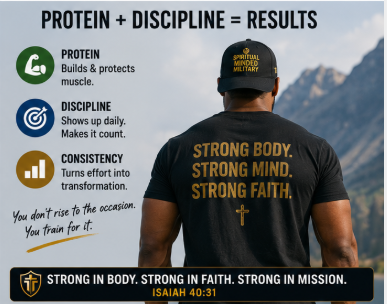
“
Whether you eat or drink, do it all for the glory of God.” — 1 Corinthians 10:31
6. So Can You Eat Cookies and Lose Weight?
Yes, if calories are low enough. You will be miserable and hungry and lose muscle.
Do you want to lose weight but can still have steak, fruit, and potatoes? Yes, if calories are in a deficit. You’ll be full, maintain muscle, and have improved bloodwork.
It’s not the magic that makes the difference. It’s adherence.
2000 calories of cookies equal ravenousness in 2 hours, which equals 3000 calories a day.
2000 calories of steak, fruit, veggies, and Greek yogurt get stuffed, and you don’t have to try for 1800 calories.
The Practical Playbook
Set protein first: 0.7-1.0 g per lb of bodyweight. 3-5 meals of 25-50g each. This deals with muscle + hunger.
Add volume: vegetables, fruit, potatoes, legumes, and broth-based soups. This is solving for the amount of fullness per calorie.
Incorporate smart carbohydrates, fats, oats, rice, olive oil, nuts, and dairy. This takes care of energy + micros + enjoyment.
Then for soul food, pizza, ice cream, wine—anything that tastes good. Use 10-20%. If it works with your calorie and protein intake, it works. This handles sanity.
The benefits of “clean eating” (nutrient density, satiety, and health) without the dogma. You know how many calories are in a food item, but you don’t convert into a robot with a food scale. No fear of hormones, no fear of carbs.
Conclusion
Calories matter. However, the key is what food you consume and how easy or difficult it will be to control your calories, maintain muscle mass, feel good for your body, and keep it on for years.
In a calorimeter, a calorie is a calorie. A calorie is a unit of information in a human being. Protein says to your body, “Build and stay full.” Fiber serves as a “slow down” signal to your body. Sugar, fat, and salt are your friend’s messages to your brain: “Eat more!
For the uniform that declares you are trained for battle, secure your Spiritual Minded Military shirt at SpiritualMindedApparel.com.
The Remnant does not transition. The Remnant re-enlists.
Spiritual Minded Military
We don’t rank, we reign.
THE LITTLE GENERAL’S DOCTRINE
THIS IS NOT A SUGGESTION. IT IS A DIRECTIVE FOR THE ELITE 1%. [BY ORDER OF THE LITTLE GENERAL]
15-YEARS DRUG-FREE | WORLD CHAMPION | VETERAN
 English